Paths Greenways Bridleways Tracks
PGBT

People unfamiliar with the area may not know exactly where paths go once they leave the metalled road. As a result, the Countryside Act 1968 requires highway authorities to signpost where the path meets the metalled road.
Section 27 says,
“(4) It shall also be the duty of a highway authority in exercise of their powers under subsection (1) above to erect such signposts as may in the opinion of the highway authority be required to assist persons unfamiliar with the locality to follow the course of a footpath, bridleway, restricted byway or byway.
(5) With the consent of the highway authority, any other person may erect and maintain signposts along a footpath, bridleway, restricted byway or byway.”
Good use of waymarking can help by informing users of the path status, improving the user experience, preventing trespass, protecting land and preventing misuse.
The current regulations for waymarks are the Traffic Signs Regulations and General Directions 2016 (SI 2016/362). See diagram 2610.2 in Schedule 12 Part 28 line 21.
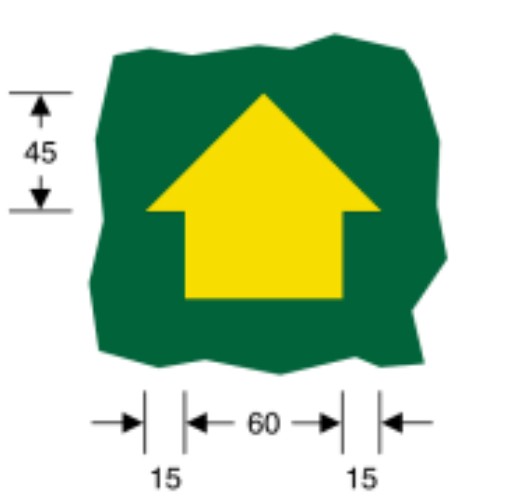 1. The direction in which the arrow points may be varied, the shaft may be extended
and curved;
2. The colour of the arrow may be varied to indicate the type of route, with
the background in any colour;
3. “Public Footpath”, “Footpath”, “Bridleway”,
“Byway”, “Restricted Byway”, “Concessionary Path”,
“Permissive Path” (or other appropriate description for conveying the
direction of a public right of way, concessionary path or permissive path) may be
added on, or adjacent to, the arrow;
4. The name of a destination, a route and an identifying symbol of a route, in
any combination, may be added on or adjacent to the arrow;
5. A distance may be added;
6. A legend may be in any style, size and contrasting colour.
The regulations no longer mandate the colour scheme. Previous regulations (such at the Traffic Signs Regulations and General Directions 2002 (SI 2002/311) mandated yellow for footpaths, blue for bridleways, red for restricted byways and byways open to all traffic, and white for routes for pedal cycles (see diagram 2610.2 in Schedule 7, shown above).
The Patchetts Green Bridleways Trust strongly recommends that the formerly-mandated
colour scheme is continued: Yellow for footpaths, blue for bridleways,
plum for restricted byways and red for byways open to all traffic.
This enables users in any particular mode to identify quickly their route
(especially where routes of differing status cross or diverge). Additionally, as so
many people will be familiar with the formerly-mandated colours, the use of those
colours for new trails will be certain to cause for example, riders to try to follow
a blue-waymarked footpath.
It is better to stick to yellow if only walking rights exist!
Natural England's publication Waymarking public rights of way provides more information about waymarking.

While every endeavour has been made to give accurate information, the law is complex, subject to different interpretations and subject to change. The contents of this website are offered to help registered supporters and general readers, but do not constitute formal legal advice.